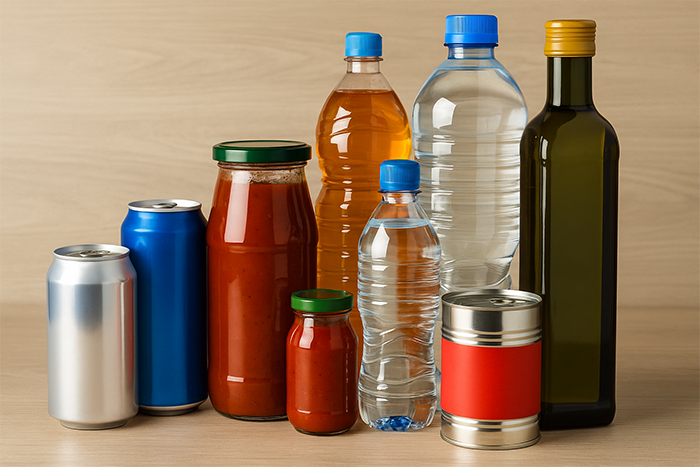
The world of packaging is undergoing a profound transformation, driven by the evolution of materials, the digitalization of processes, and the growing global demand for products that are packaged safely, sustainably, and efficiently. In the food and beverage packaging sector — which accounts for more than 60% of the total value of the packaging machinery market — these dynamics are accelerating the adoption of integrated and increasingly automated lines.
According to the 2025 Guide to Global Markets report by PMMI (The Association for Packaging and Processing Technologies, 2025), the demand for advanced solutions will continue to rise in the coming years, fueled by new lifestyles, the search for eco-friendly packaging, and the need for more flexible and digitalized processes. The future of packaging will be increasingly smart, connected, and circular, and companies capable of combining innovation with environmental responsibility will lead this evolution.
A Rapidly Expanding Market: Innovation and Sustainability
The global packaging machinery market continues to grow at a steady pace, supported by an annual growth rate projected between 3.5% and 3.9% through 2029. This evolution is driven primarily by the food and beverage sectors, which together exceed €39 billion in total value (60% of the market). This trend reflects deep changes in consumer habits:
- growing consumption of packaged, portioned, and ready-to-eat products;
- increased sensitivity toward recyclable and sustainable packaging;
- the need for faster, safer, and more automated processes.
In 2024, the most widely used technologies globally were filling and dosing machinery and Form-Fill-Seal (FFS) systems, each exceeding €11 billion in value and representing nearly 40% of the total market. Cartoning (€6.4 billion) and palletizing (€6.2 billion) also showed strong demand, highlighting the rising importance of secondary packaging and integrated logistics solutions.
By 2029, filling and dosing will remain the leading technology category, reaching €13.9 billion, followed by FFS systems at €13.4 billion. Food and beverage will continue to be the main sectors for nearly all these technologies.
Food & Beverage: The Center of Innovation in Packaging
The Food & Beverage sector is today the primary driver of innovation in packaging. Lines must ensure food safety, flexibility, and continuous production, adapting quickly to new formats and increasingly sustainable materials. Bioplastics, high-performance papers, and compostable solutions are progressively replacing traditional options.
This evolution is driven not only by mechanical technologies, but above all by the synergy between advanced automation, connectivity, and intelligent digital systems. Predictive monitoring software, supported by sensors and real-time data analysis, enables companies to anticipate failures, optimize performance, and reduce waste and energy consumption. These tools make lines more stable, efficient, and easier to maintain, contributing to smoother and more responsive operations.
Machine design follows the same principles: high energy efficiency, modularity, and ease of maintenance in line with Industry 4.0 standards. The result is a more transparent and sustainable value chain in which every phase—materials, traceability, and end-of-line operations—is integrated into a production ecosystem capable of maximizing resources and minimizing waste.
The Regions Driving Global Change
Geographically, the center of packaging market growth is shifting toward the Asia-Pacific region. Countries such as India, China, Thailand, and Vietnam are becoming key hubs thanks to rapid urbanization and the emergence of a growing middle class increasingly attentive to quality and food safety. Europe maintains leadership in innovation and sustainability, with manufacturers focusing on efficiency, reduced emissions, and flexible design. The Americas also remain strategic, with Brazil and Mexico showing steady growth.
In this global landscape, companies like ours play a key role: providing integrated solutions for the entire food and beverage supply chain, anticipating market trends, and supporting the transition toward smarter, more efficient, and more sustainable packaging.
CFT’s Vision: Integrated, Sustainable, and Future-Ready Solutions
At CFT, we believe that technological innovation must go hand in hand with environmental responsibility, production efficiency, and food safety.
For this reason, we design complete packaging lines for beverages and liquid foods, covering every phase of the process—from container washing to filling, from sealing to labeling, all the way to end-of-line operations with robotic palletizing systems.
Our technologies are designed to ensure:
- maximum final product quality,
- reduced energy consumption,
- ease of maintenance,
- high flexibility for different formats and materials,
- full integration with Industry 4.0 standards.
Our commitment is clear: to deliver complete, cutting-edge solutions that help our customers stand out in the market. This is a goal we pursue every day, together with our clients and partners, driven by the passion that has guided us for more than 80 years.
Source: 2025 Guide to Global Markets, PMMI (The Association for Packaging and Processing Technologies, 2025)